
POTR: Post Training 3DGS compression

TCSVT (IEEE Transactions on Circuits and Systems for Video Technology), 2026

Ghent University - imec

Abstract

Recently, 3D Gaussian Splatting (3DGS) has emerged as the most promising contender to Neural Radiance Fields (NeRF) in 3D scene reconstruction and real-time novel view synthesis. 3DGS outperforms NeRF in training and inference speed, but has substantially higher storage requirements. To remedy this downside, we introduce POTR, a post-training 3DGS codec which uses two novel post-training compression techniques.

First, a modified 3DGS rasterizer is proposed to accurately and efficiently calculate a splat's contribution and the change in PSNR upon its removal. Both metrics are then used to remove between 54% and 84% of splats, depending on the scene, while introducing only minor visual artifacts and without altering any other attributes. Splat removal also significantly boosts inference speeds, with some scenes more than doubling their framerate.

Second, a novel spherical harmonics energy compaction method is proposed which substantially lowers the AC lighting coefficients' entropy. Using a heavily modified version of ridge regression, up to 95% of AC lighting coefficients are set to zero while simultaneously lowering their L2 norm.

By combining these two novel compression techniques, POTR is able to achieve compression ratios upto 100x, while minorly affecting visual acuity.

Method

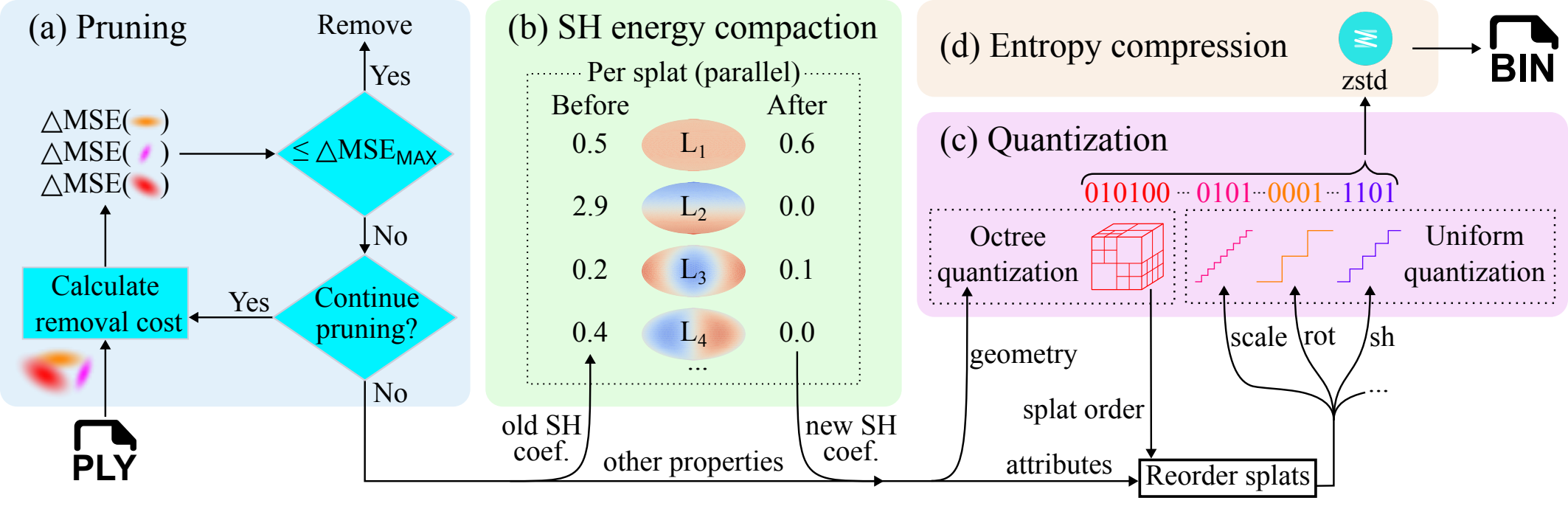
(a) Splats are removed across multiple pruning iterations based on the change in the model's mean square error (MSE) upon their removal.
(b) Spherical harmonic coefficients are energy compacted, yielding a new set of lighting coefficients with a lower entropy.
(c) Splat geometry is quantized and serialized using an octree, then attributes are uniformly quantized and serialized using the spatial order implied by the depth-first traversal of the octree.
(d) The serialized data is entropy compressed using zstd, resulting in the final compressed bitstream.

Visual Comparisons

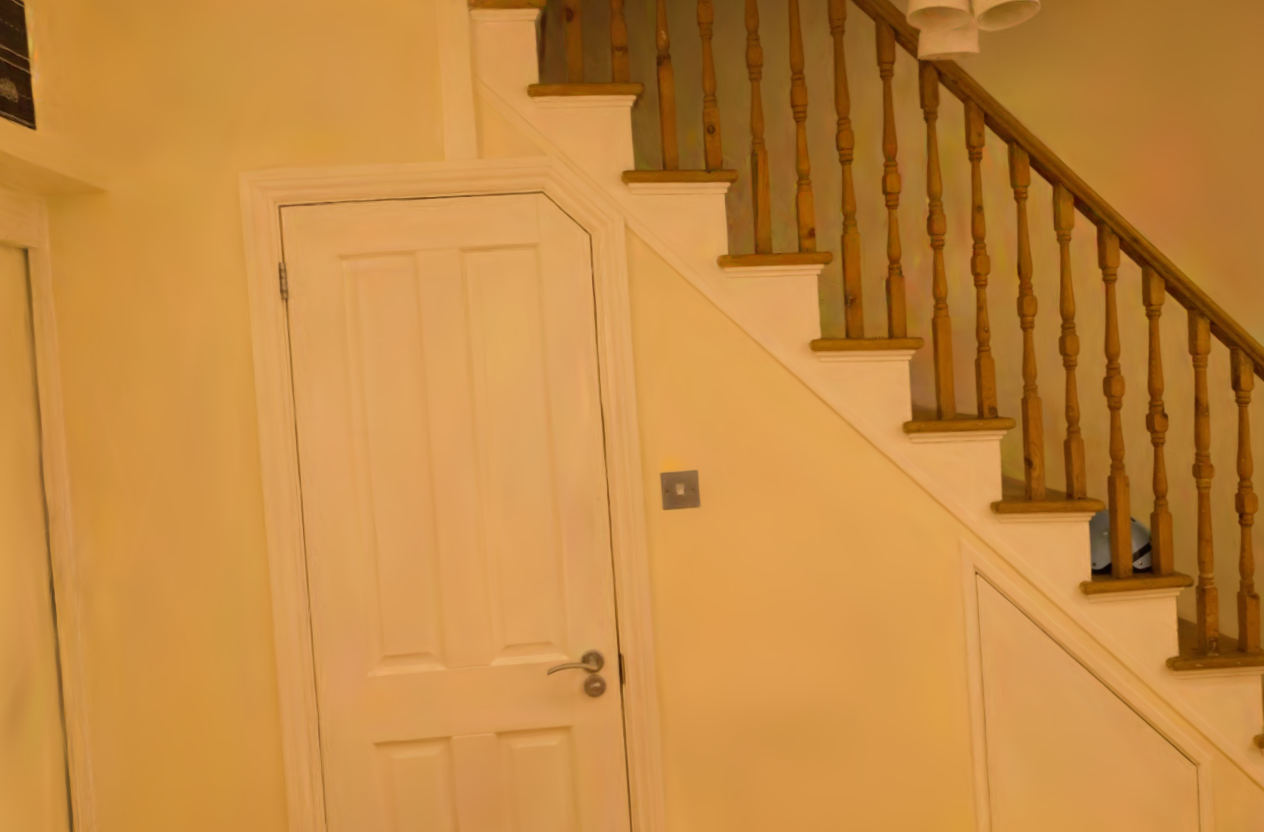
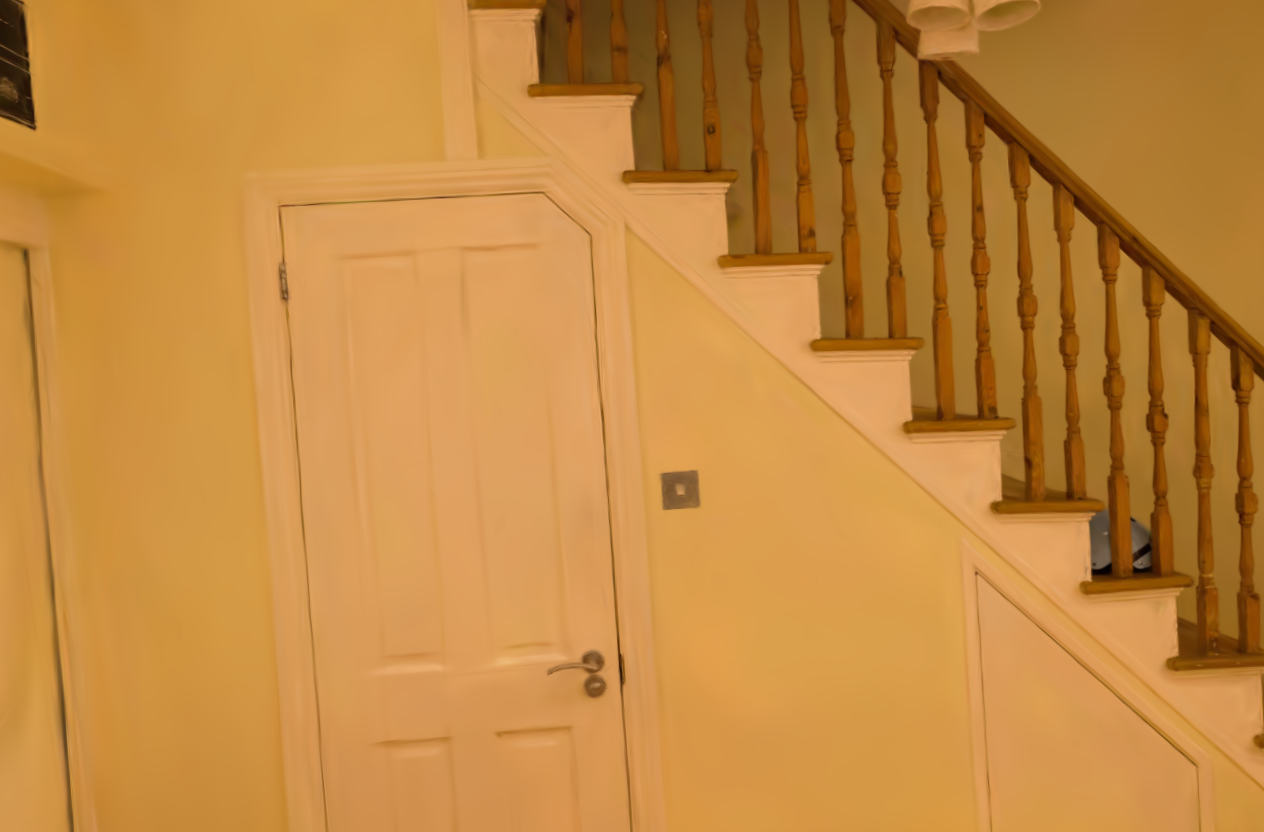
Tuning the quality factor for each scene, rather than using a single fixed value as in the paper's original visual comparisons, leads to the improved performance shown below.

Ours
11.57 MB
1,155,255 splats

3DGS [Kerbl 2023]
1,521 MB
6,131,954 splats

Ours
4.50 MB
419,872 splats

Compressed 3DGS [Niedermayr 2024]
21.39 MB
2,054,984 splats
Ours
1.95 MB
179,694 splats
MesonGS [Xie 2023]
29.02 MB
2,036,892 splats
Ours
0.89 MB
94,084 splats
Ground Truth

BibTeX

@article{ramlot2026potr,
  author={Ramlot, Bert and Courteaux, Martijn and Lambert, Peter and Van Wallendael, Glenn},
  journal={IEEE Transactions on Circuits and Systems for Video Technology}, 
  title={POTR: Post-Training 3DGS Compression}, 
  year={2026},
  doi={10.1109/TCSVT.2026.3685779}
}